


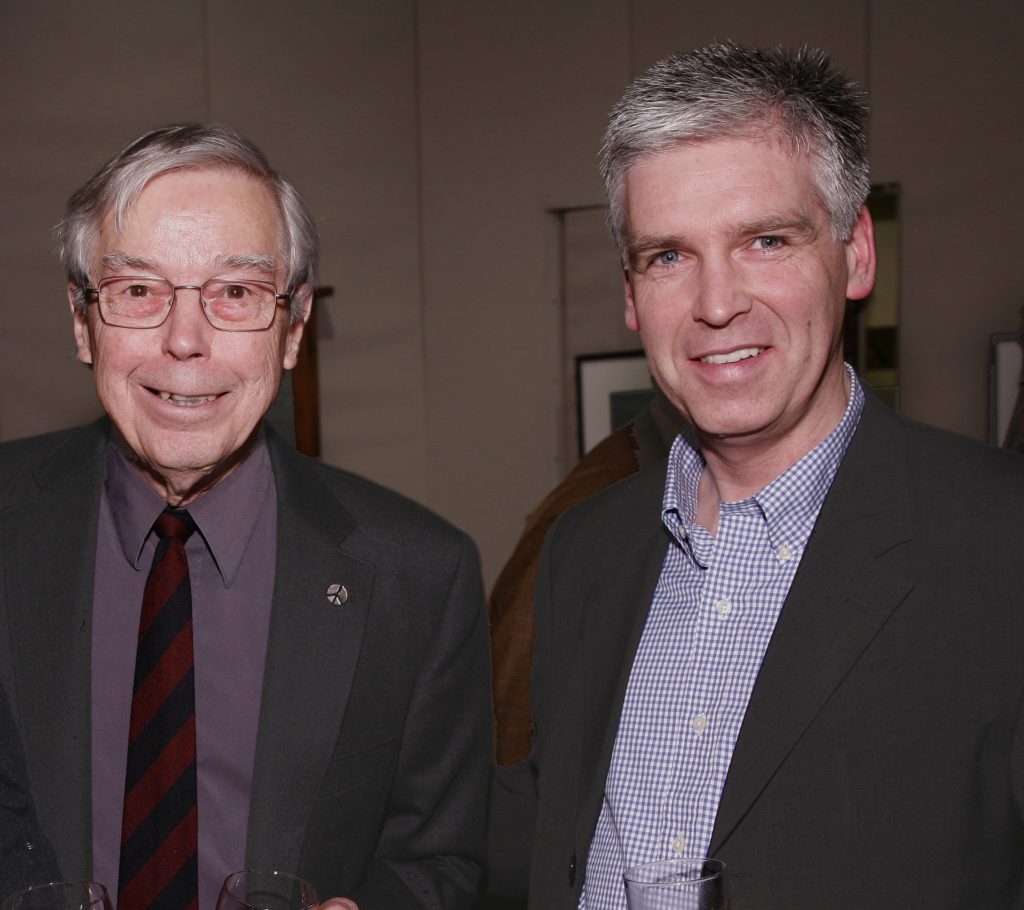
Decades after standing in awe beneath the World Trade Center, DECLAN T PHILLIPS reflects on his unexpected friendship with Leslie Earl Robertson – the visionary lead structural engineer whose groundbreaking designs saved thousands of lives on 9/11, and whose warmth and humanity defined his greatest legacy.
For many people, the Twin Towers are remembered only through the events of September 11th, 2001. But my connection with the World Trade Centre began many years earlier, on a hot summer day in 1987.
At the time, I was a structural engineering student. Along with four classmates, I travelled to the United States for the first time. The morning after we arrived in New York, there was one place we were determined to visit: the Twin Towers.
It’s easy to forget just how extraordinary the Twin Towers were. When they opened in 1973, they were the tallest buildings on the planet. Even more extraordinary was the fact that the engineer selected to design their revolutionary structure was only thirty-five years old, an age when most people’s careers are only beginning to take shape.
As we approached the towers, their scale seemed almost impossible to comprehend.
Like thousands of visitors before us, we joined the queue for the observation deck on the 107th floor of the South Tower.
As the line slowly wound around the base of the building, I stepped away from my friends and stood in the shade between the tower’s massive aluminium-clad columns.
Leaning against the cool metal, my eyes followed the endless vertical lines of the structure as they disappeared into a brilliant blue sky. Clouds drifted overhead, creating a strange illusion. For a moment, it seemed as though the tower itself was moving.
Standing there, two thoughts crossed my mind.
First, what would it be like to meet the engineer who designed these remarkable structures?
Second, what would happen if the towers ever collapsed?
At the time, these felt like impossible questions. Yet life would eventually answer both.

By autumn 2005, I had joined the University of Limerick, where we were launching a new civil engineering programme, and I had an idea for a guest speaker to come and talk to our students. I called the New York office of LERA, the engineering firm of Leslie Earl Robertson, the lead structural engineer for the Twin Towers. I introduced myself to the receptionist and asked if Mr. Robertson might be available. To my surprise, within moments I heard a warm voice say, “Hi, this is Les Robertson.”
I invited him to Ireland to speak about his remarkable career and the responsibilities that come with being an engineer. To my delight – he agreed.
That phone call marked the beginning of a friendship that has profoundly enriched my life.
Over the years, our conversations ranged far beyond engineering.
Les was a natural storyteller. Before becoming one of the world’s most respected engineers, he had raced stock cars, operated filling stations and washed dishes in diners. He spoke about those experiences with the same enthusiasm he brought to discussing skyscrapers and bridges.
But what impressed me most was not his technical brilliance.
It was his humanity.
Born in Los Angeles in 1928, Les overcame a difficult childhood marked by family separation, instability and poor experiences at school. At sixteen, he dropped out of school and lied about his age to be admitted to the US Navy. His future seemed uncertain.
But that decision opened an unexpected door. After leaving the service, still in his early twenties, he attended the University of California, Berkeley through the GI Bill. There, his fortunes changed and an extraordinary engineering career began.
Les Robertson was the kind of engineer who treated steel the way a master chef treats ingredients: use only what you need and make every bit count. Long before “innovation” became a corporate buzzword, Robertson was already pushing boundaries. In the early 1960s, he was putting IBM computers to work to speed up the design process, at a time when many engineers still trusted a pencil, a slide rule and a strong cup of coffee.
He was also among the first to use wind tunnel testing to understand how much the Twin Towers would sway on one of Manhattan’s breeziest sites. Not content with that, he built a custom motion simulator and conducted experiments to figure out how people would actually feel hundreds of metres above the streets of New York. The result was a patented damping system designed to make the towers feel steadier for those working high above the city.
And because Robertson seemed determined to think of everything, he even considered the possibility of an airliner striking the buildings. His calculations were based on the largest commercial jet of the day, a Boeing 707. Not a rogue missile, but a passenger plane lost in fog while trying to find JFK or LaGuardia Airport.


What makes the story even more remarkable is where it began. Before taking on the challenge of designing two 110-storey skyscrapers that would redefine the New York skyline, Robertson’s firm’s experience of high-rise design topped out at a comparatively modest 20-storey IBM building in Seattle. It was on that project that he first met architect Minoru Yamasaki, the man who would become his partner in creating one of the most recognisable landmarks of the twentieth century.
But the hardships of his early life never left him. Neither did his disdain for war. The loss of friends during his military service shaped his lifelong commitment to peace.
The attacks of September 11th left a profound mark on Robertson. As the lead structural engineer, he found himself thrust into the global spotlight and relentlessly questioning every design decision he had ever made. Yet the engineering community was clear in its judgement: Robertson’s pioneering “tube” design, coupled with the massive rooftop space-frame structures that bound each tower together, helped keep the buildings standing far longer than many thought possible. Even after the aircraft severed numerous load-bearing columns, those innovations allowed forces to be redistributed through the structure, buying precious time for thousands to escape. Without them, the towers would almost certainly have collapsed much sooner, and the loss of life could have been far greater.
Les dedicated much of his life campaigning against war and promoting understanding between people of different backgrounds and beliefs.
A small peace pin was rarely absent from his jacket. He frequently gave these pins away, hoping others might join his cause. He believed that, despite their differences, the world’s great faiths shared common values of peace, justice, truth and compassion.
During his visit to the University of Limerick in 2007, I was proud to see Engineers Ireland recognise his extraordinary contribution to the profession by awarding him its highest honour, Fellowship of the Institution.
Les was always generous with his time. At my request, he visited my local primary school in Tramore and gave a wonderfully inspiring talk about his career designing towers.
As the children were being collected after school, one excited young lad ran up to his mother and announced, “Mam, the engineer for the Twin Towers was in our school today!”
“He was not!” she replied
It was probably the quickest false fact-check in Tramore history.
Les Robertson passed away in February 2021, one day before his 93rd birthday.
When people remember the Twin Towers, they often think of their destruction. When I remember them, I think of standing in their shadow on a hot summer’s day in 1987, gazing up at the sky and wondering about the man who had designed them.
I was fortunate enough to meet that man. And while he designed some of the tallest structures on earth, his greatest legacy may well be the example he set as a human being.
An Extraordinary Engineer was first broadcast on RTE Radio 1’s ‘Sunday Miscellany’ on 13 September, 2026, on a programme marking the 25th anniversary of the 9/11 attack on New York. Click here to listen to the broadcast

About the Author
Dr Declan Phillips is an associate professor and formerly the inaugural course director for the civil engineering and construction management and engineering programmes at the University of Limerick (UL). He has been with the University since it first launched programmes in the built environment in 2005. He was responsible for designing UL’s programme in civil engineering, a programme that adopts a learning-by-doing philosophy.
